

Last month marked six years since I moved home to Los Angeles to pursue a project I had been thinking about for years — and that most people thought was completely unworkable: creating coliving houses run by their residents.

Since starting Zaratan, we have not only acquired a beautiful old home and converted it into the 9-bedroom Sage House, but also designed and implemented a governance model that keeps costs low and retention high. What’s more, we did all of this entirely bootstrapped, with no outside investment.1 It has been a challenging, exciting, and at times harrowing experience — and easily one of the most significant of my life. This essay will reflect on this experience, and share a few lessons learned.
Everything here is my own opinion based on my experiences of the last few years, and is not meant to represent the views of current or past housemates.
We’ll frame the discussion by sharing an operational snapshot from the past few years, as well as the project’s internal timeline, to give a sense of scale and scope.
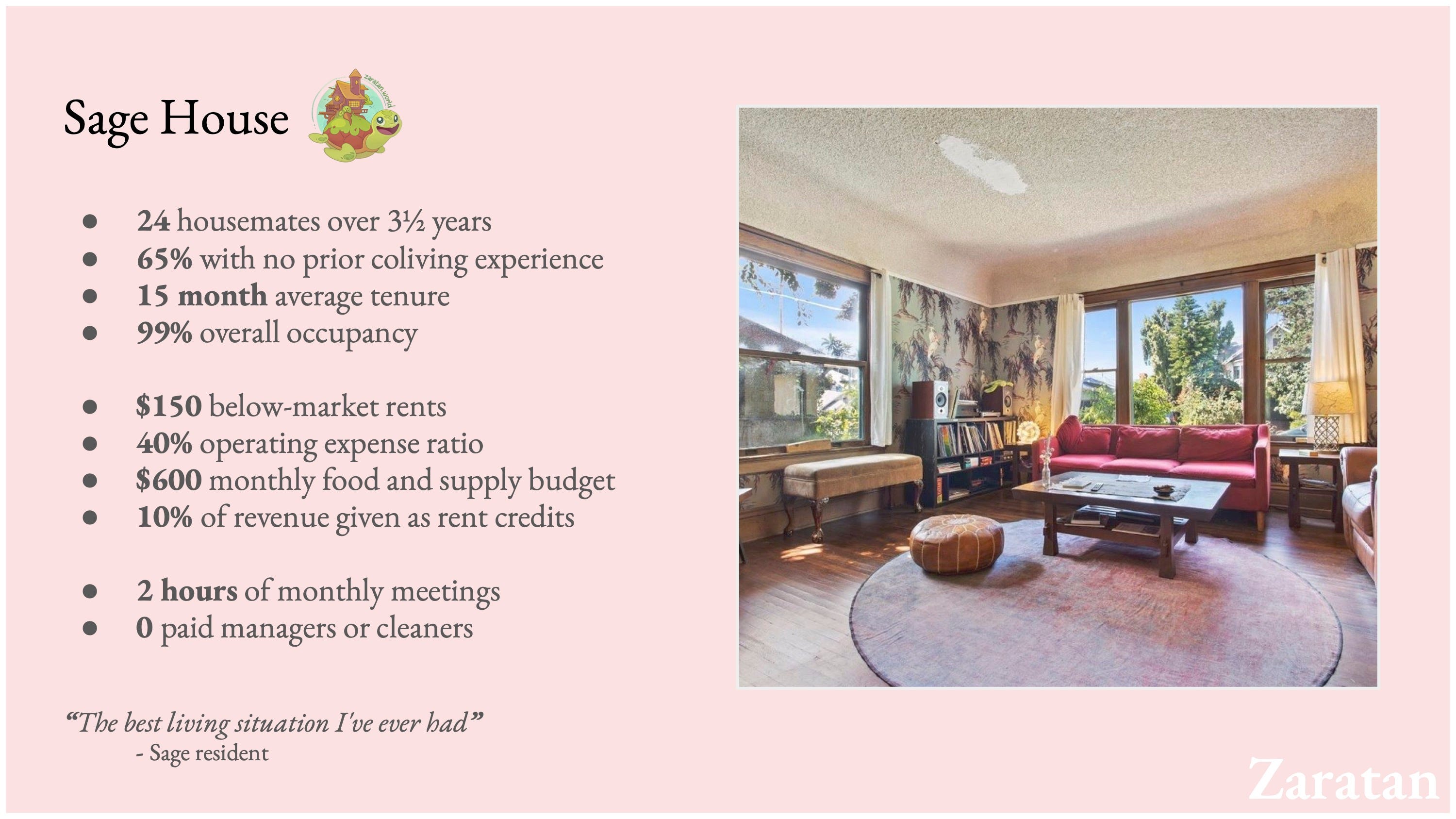
The operating data tell a compelling story — one of high demand, strong operations, and the concrete achievement of once-aspirational goals.
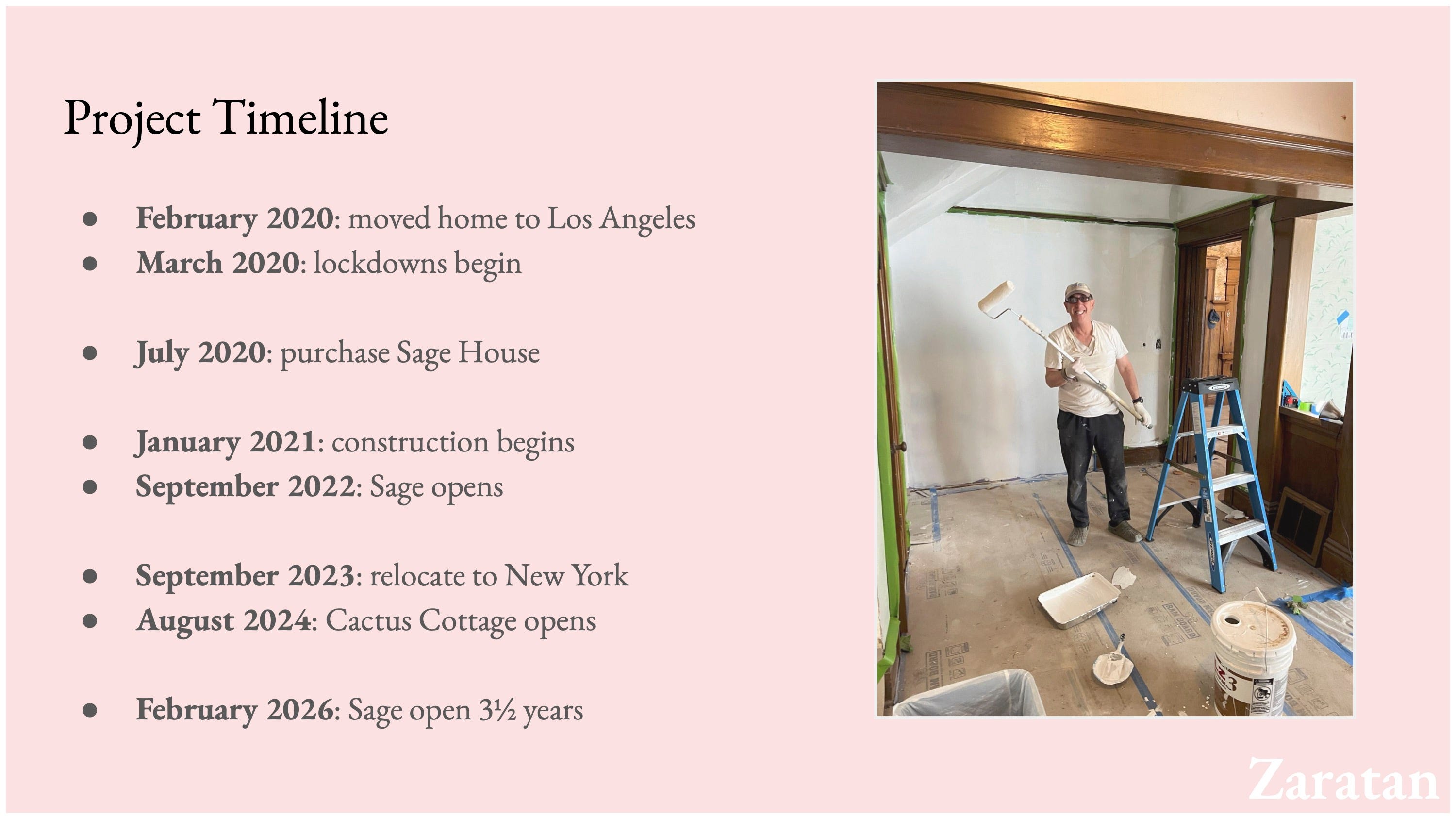
The timeline tells another story — one of perseverance and tolerance for risk. As my friend Shane put it, “you didn’t give up, and you didn’t run out of money.” Just barely.
The last few years have taught me a lot — about managing expectations, navigating ownership, sustaining community, and growing an organization. Let’s get into it.
Managing Expectations
One of the biggest lessons of being an operator, instead of a thinker or builder, is how important expectations are to shaping behaviors and outcomes. Sage was envisioned as a high-trust, permissive environment that would also open and welcoming to new people — and making that work meant getting everybody on the same page.
If someone moves into Sage thinking it’s a dorm, they’ll expect it to behave like a dorm, with high-touch services all along the way. If someone moves into Sage thinking it’s a punk squat, they’ll expect it to behave like a punk squat, and resent any perceived limits on their freedom. And if one person moves in thinking it’s a dorm, and another person moves in thinking it’s a punk squat, then they’ve formed a set of expectations that are collectively impossible to fulfill.
Psychologists use the concept of schema to describe social scripts we use to navigate recurring interactions. The reason you can walk into an unfamiliar coffee shop and order an oat-cap is because you’ve learned the schema for coffee-shop interactions, just as you’ve learned schemas for job interviews, first dates, and so on. With Sage, there was no single schema to draw on — we were genuinely trying to do something new — which invited early housemates to form all kinds of expectations.2 And because our emotional reactions are shaped less by events themselves and more by how they line up with our prior expectations, misalignment creates not only confusion, but disappointment.
Most of the friction we experienced at Sage in the early years can be traced back to misaligned expectations, and part of my own leadership development has been learning to take more responsibility for setting expectations appropriately. It’s unfair for me to present the house as a place where “you have the freedom to do what you want,” only to later (from the housemate perspective) assert arbitrary boundaries.
In fairness, I was learning as I went along.
I had relevant experience, but the specifics — who the house would attract, and what dynamics would form — were a mystery to me. My growth in this area has come in a few ways. The first was overall improvement in personal communication — learning to be aware of my own projections and emotional triggers. The second was two practices: continually improving the “Welcome Letter” given to new housemates, which provides useful context and establishes expectations for varieties of issues, and instituting the practice of a biannual “unconference” where major changes can be discussed in-person.
When managing expectations, a question arises: manage them towards what?
There’s no obvious answer. Our approach has been to try and manage them towards a level of engagement that cultivates initiative without creating over-identification. If engagement is too low, housemates struggle to contribute and the environment declines. If engagement is too high, tribal attitudes emerge and influence accrues to those who stoke “us versus them” sentiment, taxing coordination.

We do this by emphasizing the economic goals of affordability and mutual aid over the pursuit of peak experiences. This was a choice made intentionally. In Alienation and Charisma: a study of contemporary American communes, sociologist Benjamin Zablocki observes (emphasis added):
“… comparison with the achievements of small cooperative business enterprises, for example, leads to the conclusion that even under optimal conditions communal partnership is far more difficult to sustain than economic partnership. Some small cooperative business do succeed, against the odds, in reaching a stable equilibrium with stated goals achieved. It is rare to find even such a basic accomplishment among communes.”
Motivations for forming community broadly fall along a spectrum. At one end is community as affinity group: burning bright while feelings last. At the other is community as infrastructure: less glamorous, but slow-burning and durable. By organizing expectations around relatively objective goals of low costs, high quality, and predictability, it is easier to sustain collaboration over long periods of time.
Navigating Ownership
Arguably the biggest change this project has brought to my daily life came from owning and operating property.
I’ve been thinking about property ownership for a long time. As an undergraduate, I studied the works of Henry George, and the Karls Marx and Polanyi, all of whom have strong opinions on the relationship between land, labor, and capital. Through my work with various cooperative organizations, I came to appreciate the value of shared ownership as a way of aligning agency, stake, and context. My own father is a property owner, who holds the peculiar honor of being the first-ever opposition candidate elected to Santa Monica’s Rent Control Board. As a millennial, I have watched my entire cohort struggle with housing undersupply.
These questions are very alive for me.
I have also increasingly come to appreciate the often-fraught relationship between owners and renters — a dynamic which, many theorists argue, goes back centuries.3 It is a dynamic shaped by economic misalignment and caricature, where a discourse run largely off anecdotes stokes mutual hostility.
I believe that there’s room to reimagine this relationship, and to create new lines of alignment.
There is a saying among entrepreneurs that “every startup has a secret” — something that it knows but others do not. For Zaratan, there are two: that the population of people who would like to live in coliving houses is larger than the population of people able to start them, and that with the right structure, diverse residents can be consistently brought into productive collaboration with each other and with the organization as a whole.
Sustaining that collaboration requires carefully structuring how agency, stake, and context are shared between owners and renters. The foundation of this alignment is a shared context around finances. Here is a variation on a chart shared with new housemates, illustrating the short- and long-term financial dynamics of a typical rental property:
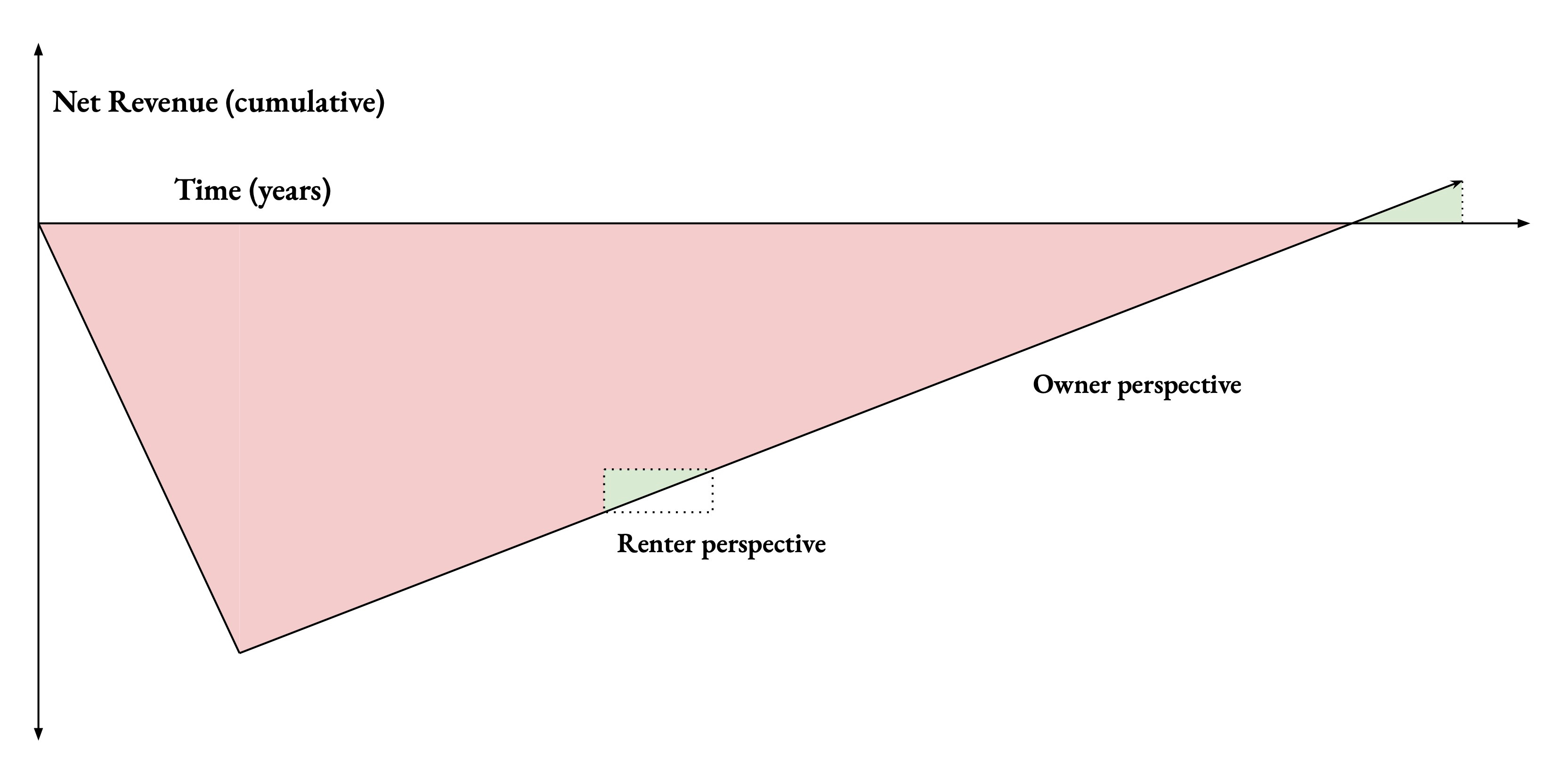
This chart illustrates the context gap between owners and renters: owners attune to the large up-front capital outlays and operational risk (red), while renters attune to the perceived profit owners receive through rent (green). Owners must navigate unpredictable (and unavoidable) maintenance and compliance costs, working towards a long-term benefit that may never come.4 Renters, lacking clarity on costs, can easily form exaggerated views of owners as wealthy, powerful, and extractive. The result is a relationship characterized by hostility and distrust.
One way Zaratan establishes context is through transparency. Every resident gets a quarterly breakdown of house finances, divided into three categories: expenses, debt, and revenue. Each category has an explicit target as a percent of income: 35% expenses (taxes, utilities, i.e. consumables), 50% debt (improvements, expansion, i.e. durables), and 15% revenue (return to investment, i.e. labor and capital). Targets are set relative to industry baselines and make it easy to benchmark financial health.5
The choice to fix a revenue target, rather than try and maximize income, helps maintain alignment. Owners typically try to keep improvement costs fixed, to maximize revenue. In our case, we try to keep revenue fixed, to maximize the funds available for improvements. This means that lower operating costs contribute not towards our own bottom-line, but to improving the property — arguably the only realistic shared goal between owners and renters, benefitting owners in terms of a more reliable asset, and benefitting renters in the form of a higher-quality daily life.
While achieving total alignment is not possible without more fundamentally shared ownership, greater transparency and credible commitment towards shared financial goals makes it possible to achieve higher levels of alignment than is typically possible between owners and renters. The net result is higher engagement, lower churn, stable expenses, and more beautiful built environment.
Sustaining Community
I’ve been thinking about communal sustainability for a long time. In the fall of my sophomore year at UC Berkeley, I proposed this concentration in my application to the selective Political Economy major:

In the years since, I have continued to engage these questions. During that time, two themes emerged: the fragility of charismatic authority, and the risk of a rising cost of administration. Durable sustainability, then, would come through reducing the reliance on heroic leadership, as well as the cost of simple, recurring tasks.
With Zaratan, I wanted to challenge myself to create an organization that was sustainable in exactly these ways. Financially sustainable, with income covering the long-term cost of operations, improvements, and capital. Socially sustainable, with operations not depending on either charisma or exploitation. These ideas are larger than coliving, but apply to coliving all the same.6
Regarding financial sustainability: As I’ve written about in “Coliving’s Political Economy” and “The Tragedy of Microapartments,” there are two equilibria for professional coliving: high-cost, high-touch, high-churn, and low-cost, low-touch, low-churn. While neither is inherently better than the other — the principle of discounted cash flows shows that large, volatile cash flows can be equivalent to small, stable ones — the approaches imply different organizations and experiences. I personally gravitate towards the latter, because I believe it is more resilient, and also because it leaves me more time to write ponderous essays and pretend to make art.
Our approach to financial sustainability was mostly covered in the last section and won’t be rehearsed here.
Social sustainability is more subtle, but broadly involves reducing the “bus factor” of a community, by making it easier to flexibly fill key roles. While most organizations are structured around the idea of fixed and stable leadership, one of the lessons of the cooperative movement is that leadership is not some special quality possessed by a few, but a latent quality possessed by everybody. The key is ensuring that leadership can emerge when and where it is needed.
That same semester I applied to Political Economy, I was living in Casa Zimbabwe, a 124-bed house in the Berkeley Student Cooperative known for its lively and irreverent culture. The student-elected management team — “a biker gang,” in one housemate’s words — would tolerate destructive behavior, including a practice of throwing glass bottles off the balcony into the courtyard below. People were unhappy with the situation, but few felt they could take action. Over several months, I watched a group of residents cohere into a political bloc, unseat the incumbents, and clean up the broken glass.
This experience of political awakening and agency in a coliving house was not a one-off, but a feature of the model. Arizmendi Bakery founder Tim Huet’s “A Cooperative Manifesto” names this explicitly (emphasis added):
… members of worker cooperatives learn democratic skills and ways of interacting with each other — and the confidence that comes from taking control over your life — that have benefits for their families and larger communities, and can carryover into the political realm. … In addition to producing bread, bicycles, etc., we produce hope and inspiration.
Leadership is always latent, but not all structures let it emerge.
When doing research for Zaratan, I read Raph Koster’s “The Trust Spectrum,” which explores power-sharing in the context of multiplayer games. In soccer, leadership is fluid, and responsibility shifts between players depending on the situation. In football, by contrast, roles are rigid and concentrate responsibility on a few key players. At CZ, housemates were stuck until the next election. Better governance would facilitate a fluid movement of power, enabling people to contribute when and where they have the most to offer — while continuing to mitigate the risk of capture and disengagement.7
The following chart provides some intuition for thinking about the ideal role of structure and of leadership: invisible during good times, stabilizing during bad times.
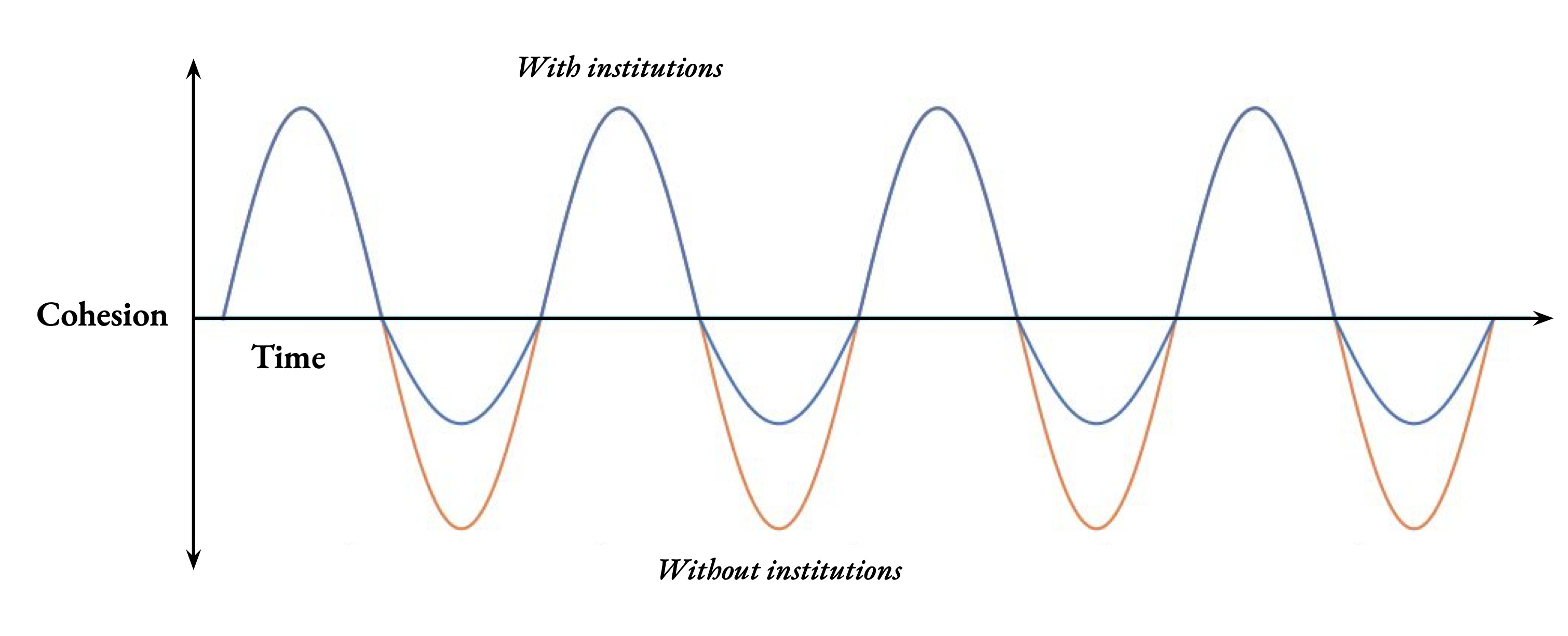
In any group, some will care more than others. This can be a good thing — enthusiastic participants are a source of inspiration, and outsized contributions can become a source of meaning for those who make them. But unevenness of contribution is a risk when it leads to burnout — the abrupt departure of an overcommitted leader creates a resource gap that others may struggle to fill.
This perspective applies to labor as well as leadership. Many coliving houses solve the problem of chores by hiring cleaners — a straightforward fix for a common source of friction. Less often examined is the assumption this solution depends on: the continued availability of a low-cost labor pool. If that pool disappears — due to higher wages, or immigration restrictions — these communities may struggle to adapt. Groups able to internalize their regenerative labor are better equipped to navigate these shocks.
Leadership and labor share a common risk: exploitation. Stripped of its moral connotations, exploitation simply describes contributions that exceed compensation, and in that sense, functions as a hidden subsidy. Groups that rely on such “subsidies” — whether from heroic leaders or underpaid workers — are structurally exposed to circumstances beyond their control.
In the final analysis, financial and social sustainability are linked, describing a group’s ability to sustain the conditions of its own existence. The more a community is able to meet its own needs, the more resilient it will be over time.
Growing an Organization
Over the last six years, two things have become increasingly clear to me.
The first is that Zaratan’s approach is more or less spot-on. Our thesis — that new institutions can make coliving more accessible, robust, and sustainable — has been largely proven out.
The second is that Zaratan is too small. As a solo founder operating a single house, every decision feels acutely personal. With my last six years so bound up with a house full of other people, it can even feel as though I’ve lost the right to tell my own story. At a larger scale — five or ten houses, two or three staff — Zaratan would evolve from being my personal project into a brand capable of carrying the weight of people’s expectations — while giving everybody more room to breathe.
To give an analogy, Zaratan is like an ungrounded electrical outlet. Small tensions build up, leading to tiny “shocks” as minor interactions get experienced through the compound lens of my many roles: homeowner, system designer, property manager, thought leader, financier, handyman. There’s no place for excess energy to go. A larger Zaratan would be like a grounded outlet, with surplus energy going safely back to the earth. More staff would allow for clear separations of roles, and I could continue my advocacy without anybody feeling like they were personally under a microscope.
I think this is achievable. As readers of this blog know, one of the goals of this “new institutions” approach is to enable exactly this kind of scale without creating the kind of out-of-control operational costs which brought down so many others. Resident self-governance, lean operations, and intentional growth all point towards a future of more houses within a shared framework — a future of more housing, more connections, and more abundance.
This growth does not necessarily need to come from us. I will admit that when I first started this project, I had a secret plan. We’d do the first house — pay for everything, on our own terms — to prove the model. We’d work in public, tell everyone how we did it, give the tools away for free. Slowly, people would start to copy us. One house would become fifty and then five hundred, and a wave of naturally affordable coliving would sweep the country.
That hasn’t happened, and on some level it’s a shame. People talk constantly about the need to reduce housing costs, to revitalize democracy, to tackle the problems of loneliness and isolation. I’m often tempted to say “Hey, look over here! We’re doing it, everything you want. Not theory, but practice — for years! It even makes money. We wrote it all down, you can just copy us — we’ll help you.”
Nobody’s biting. On the contrary, folks are skeptical. When I talk to real estate people, they’ll tell me that Sage is a fluke, or that it only works because I am so “high-EQ.” They think coliving is a headache, too complicated, a dead end.8
On some level, I get it. I see the implications, but for most people Sage is a quirky one-off. Unless you’re already bought into a vision of new institutions — and not jaded by the last thirty years of globalization, or tech, or crypto, or burning man, or any other aspirational movement which failed to bring durable social change — skepticism makes sense. I don’t think there’s been a moment in my lifetime where these ideas have been less fashionable. But that doesn’t mean they’re wrong.
Behavioral change is hard, and aspirational behavioral change which runs against prevailing moods is harder. It’s not that things aren’t working — people love the house, the writing, the tools — it’s just that the broad impact I hoped for will take longer than I wanted it to. As interesting as Sage is, there are genuine confounds — maybe the location was just perfect, or the housemates (all 24 of them) were exactly the right ones, or despite all efforts, my personal charismatic authority is still essential to keeping things running.9 As long as these questions stay open, observers may, reasonably, attribute outcomes to circumstance rather than to design.
While all of these questions can be resolved, the process will not be quick — ironically, it seems as though building the house might have been the easiest part.
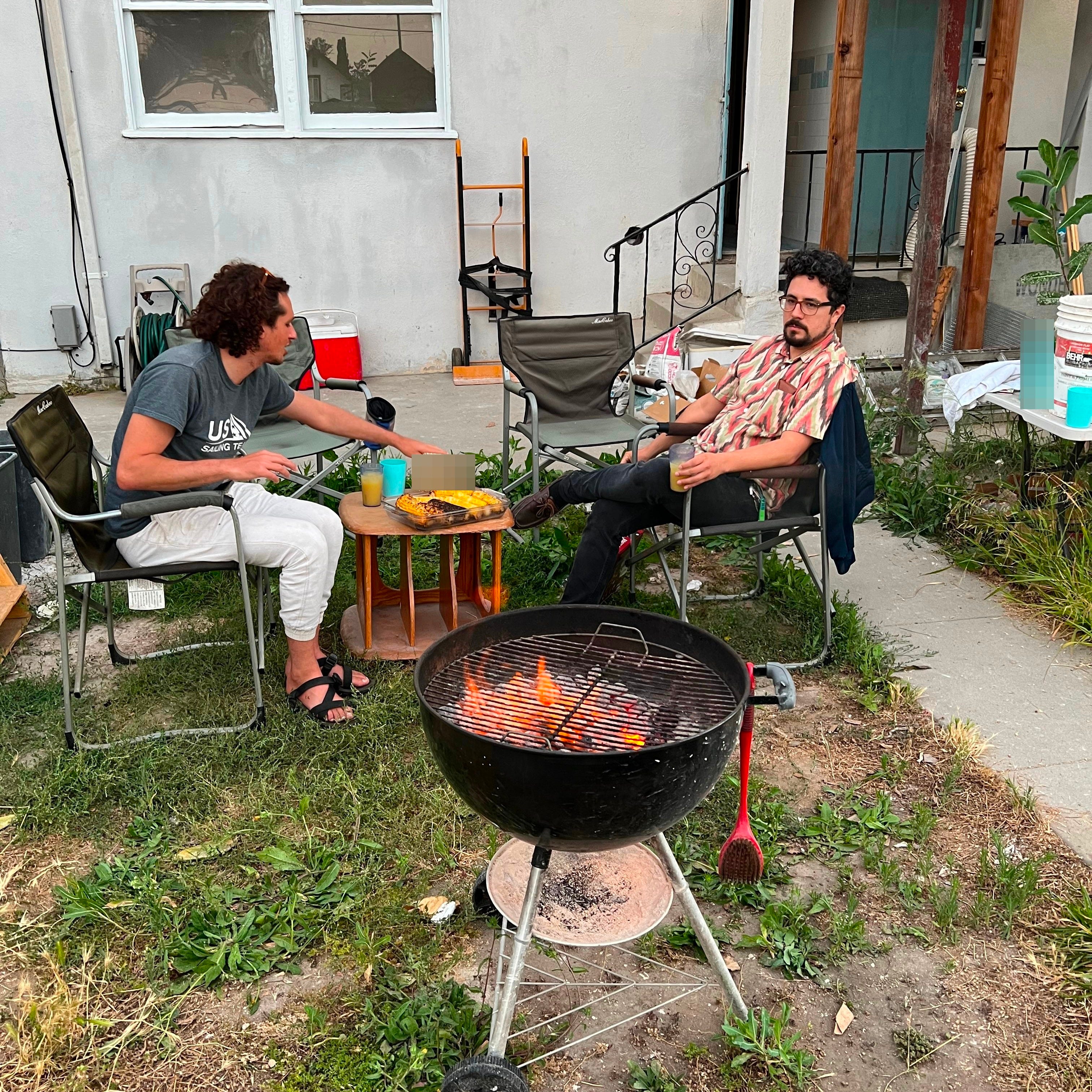
On balance, this project has given me a lot. I’ve shown I can pursue a complicated project from start to finish, preserve capital, and navigate legal, regulatory, and financial obstacles. I’ve gotten to translate complicated ideas from theory to practice, and design and implement tools that real people use. I’ve learned how to work with lawyers, lenders, contractors, and bureaucrats, to communicate better, and to manage my emotions under stress. I’ve seen that my judgment, while not perfect, is generally pretty good. And most importantly, I’ve learned who my friends are, and how to be a better friend to them.
For better and for worse, there has not been one moment in the last six years when my life wasn’t defined by this project. I’ve experienced fear of failure — of things falling apart, of going bankrupt, of being proven a fool. I’ve also experienced the fulfillment which comes from whole-heartedly pursuing something deeply aligned. There were times where I wish I had never done this, and times where I felt grateful to have been able to devote myself so fully to a vision. As my dad would often remind me, none of this happened by chance — I went to great lengths to put myself in exactly this circumstance.10
As this blog makes abundantly clear, I believe in the power of well-designed and well-run institutions to bring about greater inclusivity and abundance. In its own small way, I’ve hoped that this project could be an example of just that. Six years in, something real has been built — and there’s still much more to do.
I co-own Sage with my father, I run Zaratan on my own.
In a particularly colorful instance, one early housemate asked me if I had put cameras in the bathrooms — which I thought was an interesting thing to say.
After we bought Sage House, a good friend of mine told me that, while he still liked and respected me, he trusted my opinion less now that I owned property — another quite curious thing to say.
In one unforgettable example from a few years back, some folks in San Francisco convinced an owner to renovate his building to make it more “coliving-friendly.” He didn’t get permits, a neighbor complained, the city shut him down, and the bank foreclosed on the house.
Those with real estate experience will note that a 35% expense ratio and 50% debt level implies a 1.3x DSCR (debt-service coverage ratio), viewed as very safe by lenders.
A metaphor I like is coliving as a “bonsai tree” of political economy — revealing key dynamics in miniature.
For another perspective on the same idea, we can make an analogy to distributed systems. Most make “honest majority” assumptions — that at least 51% of participants are honest — while some specialized systems require only one “honest actor” to maintain alignment.
Some months ago I was talking to an experienced real estate investor who had gotten burned on a coliving project. He told me quite confidently that the only way that coliving could work was if the residents never had to see each other — which was… you get it.
The irony of which is not lost on me.
Why exactly I did that is a question best left to my analyst.