

This essay is an expanded version of a talk given at the Metagov offsite in April 2026. Thanks to Phil Levin for feedback on an earlier draft.
In his 1980 Alienation and Charisma: a Study of Contemporary American Communes, American sociologist Benjamin Zablocki describes communes as:
… decision-making arenas within which human purposes, dreams, and desires interact and contend with structural necessities. … For the systematic examination of these various ways of trying to modify social structure, communes … constitute a useful natural laboratory.
While the scientifically-coded language of “laboratory” comes with historical baggage, Zablocki has a point: coliving houses are good places to try things out. Their small size makes it easy to get buy-in, their function as housing means that they must navigate a full range of social phenomena, and lastly, people drawn to shared housing tend to be relatively open to new experiences.
As a result, communitarian housing movements regularly produce “folk science” in the form of field reports, experiments, and other artifacts, which get passed around via word-of-mouth and influence subsequent practice. This essay will review some past work of this type, with a focus on governance — specifically the governance of chores — and attempt a broader analysis.
Chores are interesting because, relative to other types of contribution, they are unglamorous and repetitive — you take out the trash, then you take out the trash, then you take out the trash. The intrinsic motivations that drive people to make art, plan events, or lead organizations are largely absent in low-status domestic work; as such, chores require more structure to organize and incentivize. As Dorothy Day famously said, “everybody wants a revolution, but nobody wants to do the dishes.”
This essay will explore three approaches to chore organization: paper chore charts, bragging boards, and dynamic, digitally-mediated chore systems, arguing that digital systems in particular offer a structural innovation — the ability to decouple work definition from work performance — that meaningfully expands the design space.
Prior Work
Beginning in the 2010s, the Haight St. Commons in San Francisco emerged as a hub of communitarian practice. The intersection of an abundance of historic Victorian mansions with a population of playful and technically-minded residents gave rise to an enthusiastic local movement eager to experiment and share learnings.
Explorations into community governance (2016)
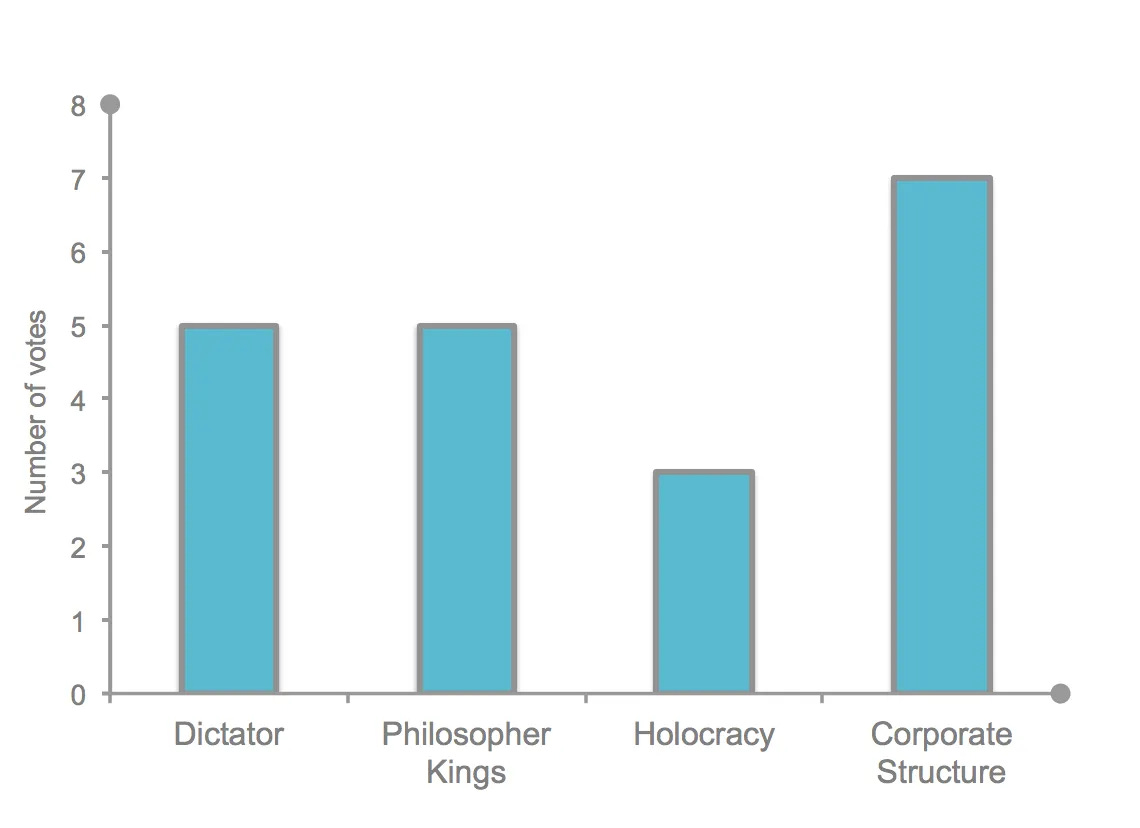
In 2016, Zarinah Agnew of The Embassy published “Explorations into community governance — observing primates in the wild,” documenting a series of four governance “experiments” carried out over eight months in 2014. Over this period, they tried do-ocracy, wiki-ocracy, corporate governance, and holocracy, choosing systems via house-wide vote. Each system was trialed for a period ranging from a few weeks to a few months, with weekly surveys enabling longitudinal analysis of the effects of each system on housemate well-being.
Do-ocracy
Under do-ocracy, motivated individuals act freely within bounds. The goal is to avoid the demotivating effects of bureaucracy by minimizing meetings and approvals and encouraging people to act spontaneously, as long as they communicate well and demonstrate empathy for other people’s wants and needs. This attitude is usually summarized as “good enough for now, safe enough to try.”
Wiki-ocracy
Under wiki-ocracy, proposals are developed in discussion with all residents (in-person or via email), then voted upon by a randomly-selected subset of residents (a process known as “sortition”). This intensive parliamentary procedure helps more voices to be heard, but requires a higher level of buy-in and investment from participants.
Corporate Governance
The tongue-in-cheek approach of “corporate governance” involves a fraction of housemates being appointed as “executives,” directing the behavior of the other residents. This approach caused friction at The Embassy and was soon abandoned.
Holocracy
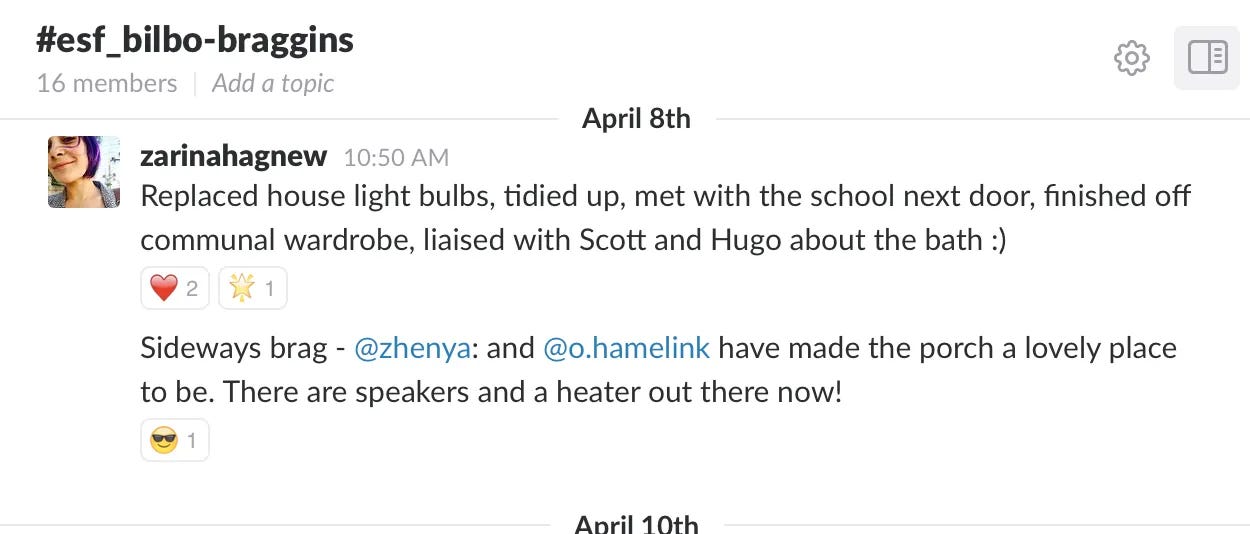
Under Holocracy, people self-select into small domain-specific groups, and are encouraged to act freely with inspiration, similar to do-ocracy. An explicit goal of this trial was to increase resident appreciation for one another, encouraged via a “bragging board” where residents could publicly “brag” about their contributions:
At the end of the experiment, the house summarized their findings:
Overall, doocracy reigned down on high, as the structure that maximised all metrics. We returned back to doocracy at the end of it all, but we kept aspects of other systems in place. We still use parts of the wikiocracy, and [the bragging board] remains a firm fixture.
“Explorations” is a great article and worth reading for anyone interested in communitarian governance. For our purposes, the essay’s main contribution was the introduction of the “bragging board” as an institutional arrangement for structuring and incentivizing domestic contributions.
Fairness is overrated and bragging is underrated (2020)
In 2020, Phil Levin of RGB and Radish built on “Explorations” with “Fairness is overrated and bragging is underrated,” extending the argument for bragging boards as a drop-in alternative to paper chore charts.
“Fairness” begins by critiquing paper chore charts on three grounds:
The expectation is perfect compliance, which is then taken for granted.
The set of tasks is limited and pre-defined, and thus difficult to adapt.
Obligation displaces gratitude, framing contributions as repayments of debt.
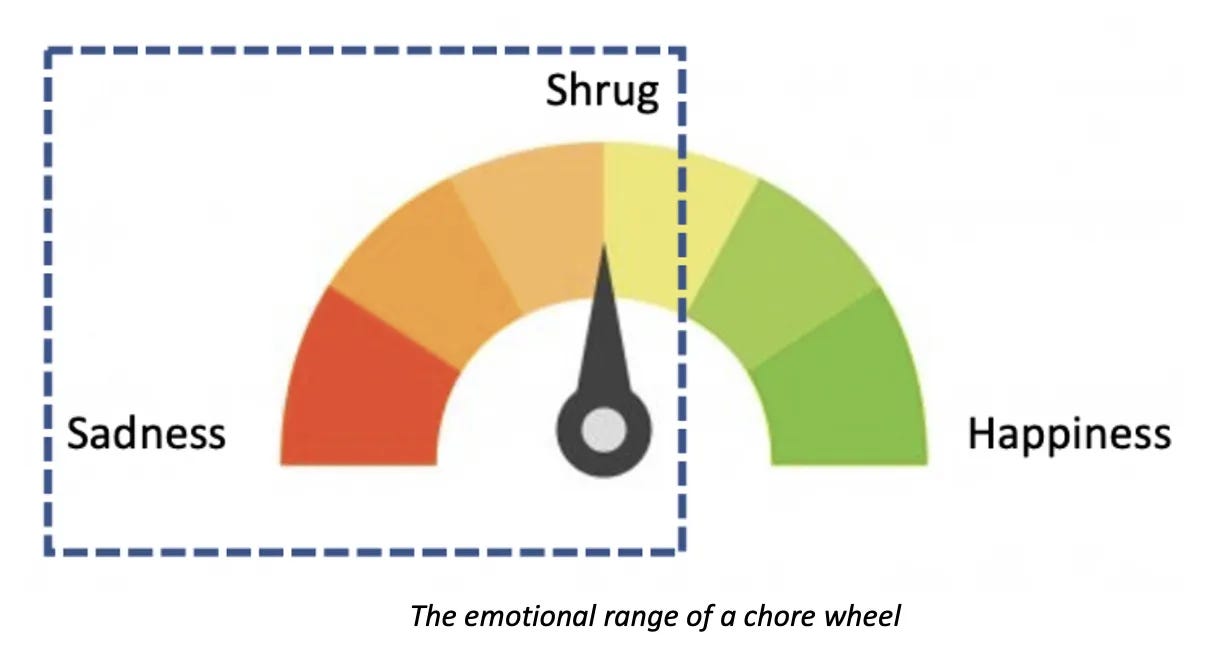
It concludes that the paper chore chart is “the physical manifestation of our desire for fairness,” and proceeds to argue against fairness as an organizing principle:
I want to make the case against fairness.
Fairness is a scarcity mindset.
The scarce thing that a chore wheel tries to allocate is people’s level of contribution. It conceives of contribution as a non-renewable resource in a contribution economy. Creating more desire to contribute is impossible or costly.
“Fairness” then argues in favor of unequal contribution, citing the Wikipedia statistic that 77% of pages are written by the top 1% of contributors. Motivated by a feeling of abundance, the essay suggests, people can be motivated to spontaneously contribute far beyond the limits of any quota.
To encourage this culture of spontaneous contribution, the paper encourages groups to adopt bragging boards as institutional alternatives to the paper chore chart:
Bragging is the fuel that sets the Brag Sheet flywheel spinning:
1. It allows people to see all of the abundance that is being done for them
2. It allows people to get credit and recognition for doing things.
3. It ingrains a social norm that people contribute without being asked.
“Fairness” then engages the natural rebuttal, which is what to do about the problem of unequal contribution. It begins by reassuring the reader that most things still do get done, and then encourages people to accept unequal contribution as the price of spontaneous generosity — with the asterisk that people who consistently fail to contribute might need a talking-to. It concludes: “My coliving wisdom for you: Capture the upswings and don’t begrudge the downswings.”
“Fairness” is widely read among grassroots coliving communities, and I’ve been asked more than once whether my work with Chore Wheel was inspired by their design.1
I am going to critique this essay, but first I want to give Phil a lot of credit. While he doesn’t use this language, he’s engaging with the problem of alienated labor that runs through western social thought, from Charles Fourier to Karl Marx to Herbert Marcuse, and is reaching for the same goal — that of positive-sum, joyful contribution. His identification of the risk of “displacement” of natural motivation by formal incentives is well-established in behavioral economics. And his alternative — a bragging board — is a genuine innovation that leverages digital tools to enable real-time recognition of individual contributions.
Cybernetic Governance in a Coliving House (2024)
In 2024, Seth Frey, Joe DeSimone, and I published “Cybernetic Governance in a Coliving House” describing the first 18 months of Sage House, the 9-person coliving house that I co-own and help run in Highland Park, Los Angeles. Using a suite of digital tools called Chore Wheel, Sage was able to run at 98% occupancy with below-market rents, relying on minimal external management and one 90-minute monthly meeting. Residents have described Sage as “the best housing they have ever had.”
Inspired by American economist Elinor Ostrom’s work on natural resource management, we tried to describe how Sage’s digital infrastructure — three Slack apps called Chores, Hearts, and Things — gives residents the tools to achieve complex coordination goals more effectively and at a lower cost than alternatives:
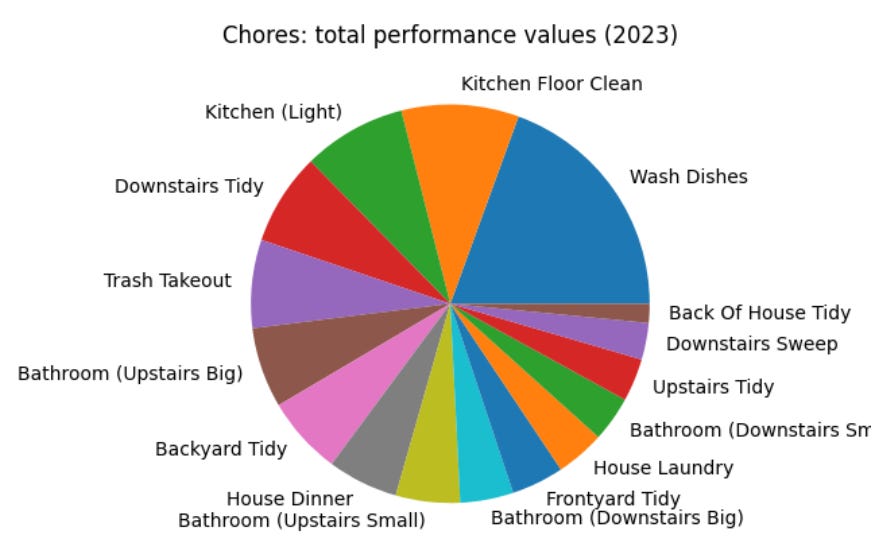
The centerpiece of the approach is the Chores app, a community-currency and “contribution system” in which residents complete predefined “chores” in exchange for points. Some notable features of the tool:
Chores do not have fixed values, but increase in value the longer they go undone.
Residents may do any chore at any time, subject to a 100-point monthly quota.
Residents may “prioritize” important chores, increasing their relative value.
Chore claims are posted publicly and are “upvoted” by other residents.
No single “manager” owns the system; decisions emerge bottom-up.
The result is a system that enables participants to achieve high levels of coordination without the frustrations and limitations of simpler alternatives like paper charts. It’s worth noting that both “Cybernetic Governance” and “Fairness” start with the same premise — that paper charts are too primitive for contemporary coliving — but take different paths towards different conclusions.
The goal of “Cybernetic Governance” was not to show off Sage House, but rather to use the house as a case study for advancing a broader theory of governance, summarized in four design principles. The Slack apps discussed in the paper are examples of these types of tools, not exhaustive of them:
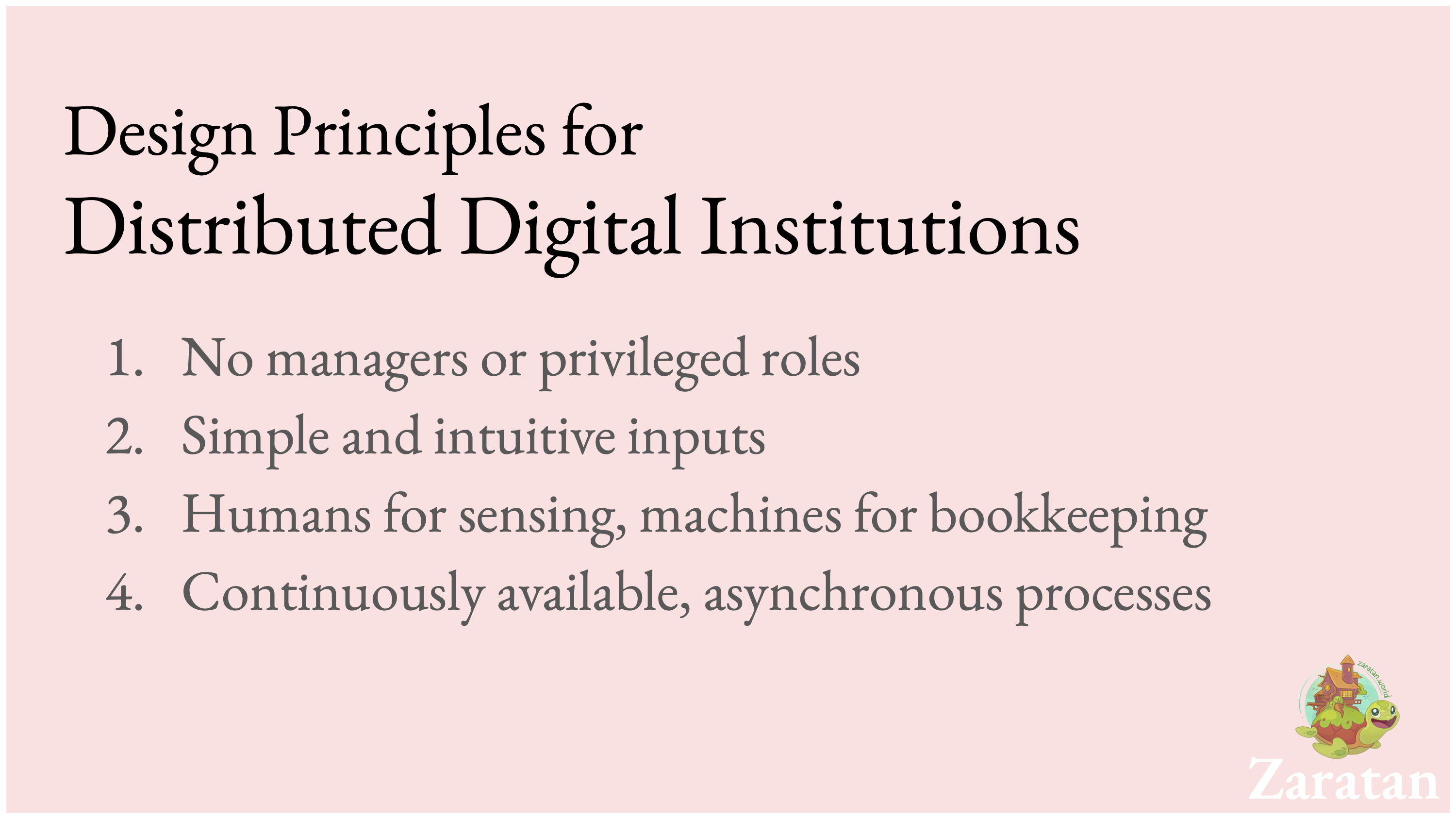
The vision is one of digital infrastructure which avoids the limits of “managers-and-meetings” procedural governance by allowing small, spontaneous contributions to compound, leading to rich and structured emergence. By combining accessible digital interfaces with thoughtful mechanism design, participants gain wide latitude in their decision-making, without introducing a high risk of cheating (and consequential need for management or social policing) that this flexibility would otherwise entail.
The paper concludes by acknowledging that while one house doesn’t prove much, it’s unlikely such a distinctive result would have occurred purely by chance. As more people adopt these tools, and they are stress-tested in more scenarios, the picture will get clearer.
Discussion and Analysis
In the second half of the essay, we’re going to unpack and evaluate these arguments in more detail. We’ll start by critically exploring the tensions implicit in hiring out domestic labor, discuss why digital systems represent a major advance relative to alternatives, and close by re-evaluating the strengths of bragging.
Conflict-of-Interest Disclosure: I am a co-designer of Chore Wheel and co-owner of Sage House. While I try to approach these discussions in the spirit of scholarship, I am also motivated to present Chore Wheel as a step forward.
Unpacking Hidden Subsidies
Both “Explorations” and “Fairness” downplay a material fact: in all cases, bragging boards are supplemented with hired cleaners.2 This omission complicates their argument for bragging boards as improvements over paper charts by obscuring the external inputs that their houses actually depend on.
Both essays, but especially “Fairness,” invite the reader to conclude that the exchange of “consistency” with “flexibility” is net neutral on contributions: perhaps some might do a little more, and others a little less, but overall the same amount of stuff will get done.3 What these essays do not say — but what the data otherwise suggests — is that the exchange of consistency for flexibility is net negative on contributions, creating a dependency on external inputs (cleaners) to maintain equilibrium.4
The goal of this section is not to make a normative argument that hiring cleaners is somehow “bad” — that would be obnoxious, and division of labor is a foundational concept. Rather, it is to complete the economic analysis and show that bragging boards should be understood as partial institutions that depend on external labor to function, and are not apples-to-apples comparable with more advanced digital systems.
The topic of hired domestic labor can be nuanced and delicate, raising uncomfortable questions of gender, race, and class. With that in mind, we’ll keep this to two closely-argued points: their cost, and their contradiction.
The Cost of Cleaners
There’s a phrase that gets passed around among grassroots coliving groups, which is that “with enough people, cleaners are basically free.” This is a slippery argument, bound up inextricably with the economic conditions of these same workers.

Consider the Instagram ad above (screenshot of a video). It advertises a “discounted” cleaning price of ~$9 / hour, down from a sticker price of $25 / hour. Assuming the sticker price and a 30% company take, the worker is making $17.50 / hour, just above New York and California minimum wage. Someone working full-time would take home $35,000 before taxes, putting them at the bottom of the “very low income” category in SF, LA, and NYC for a family of one.5
A 10-person house with weekly six-hour cleaning would spend $600 / month at the minimum-wage rate, or $60 per resident. For these workers to be making the area median income, the cleaning price would need to go up about 3x, to $75 / hour — creating a monthly per-person cost of $180.
Last fall I had the opportunity to visit The Embassy (the subject of “Explorations”) while in San Francisco for the Community Living Wisdom Exchange, where I gave a workshop. While there, I inquired into the house’s logistics, and found that they hire a 5-person cleaning team twice per month. Assuming a 6-hour cleaning, that’s 60 hours of cleaning per month, at a cost of between $1,500 - $4,500, or $100 - $300 per person split among 14 residents.
Asking about their pricing, I found that The Embassy charges a monthly “community fee” of $700 on top of room rent. These community fees are common in coliving houses, often covering utilities and various levels of food service. During the Wisdom Exchange’s “co-op crawl” I got to visit RGB (one of the subjects of “Fairness”), and learned that their community fee was $250 and had a similar purpose of cleaners, utilities, and food service.
I’ll contrast this with Sage House, which doesn’t hire cleaners and has no community fee (utilities and basic food service are included in base rent):6

Assuming per-room rents of between $1,400 - $3,000, these community fees represent an additional ~15% - 40% in all-in housing cost. There is no such thing as a free lunch: the “cheaper” the cleaners are, the less they are being paid, and the more fairly they are being paid, the less cleaners can be presented as an “essentially free” solution.
The Contradiction of Cleaners
There’s a second and more subtle dimension to cleaners: they challenge the communitarian ethos itself. In Alienation and Charisma, Zablocki interviews members of dozens of urban communes about their shared values. One of his key findings is that while communitarians hold diverse views on a range of social issues, the most widespread point of agreement is that love is a core value — not necessarily the finding of it for oneself, but of acting lovingly with one another:
The commune sample is nearly unanimous in its high regard for only one value: loving. … Truly, it can be said that love is the common coin of the entire communitarian movement.
Zablocki was writing in the 1970s, but this orientation persists: the Haight St. Commons’ own values statement puts “A sense of belonging for all humans” at the top of the list. It is not hard to see why the reliance on human labor outside of the house’s own social sphere creates internal tension. Hired cleaners are typically not part of the house social life — they are not invited to parties, not included in house meetings, and not known by name to all residents. The house with cleaners depends on those whom it excludes.
This creates a contradiction between inclusion and exclusion, which everyone handles in their own way. There isn’t great data on this, but anecdotally, cleaners seem to almost always be discussed obliquely, apologized for, or — notably — left out entirely.
One striking example comes from the 2024 iteration of the CWLE, in a lightning talk session on chore systems.7 In the second talk, some residents of RGB present the bragging board as an alternative chores system, only to reveal in the final moments that the house relies on cleaners. The full transcript is worth reading:
[ Ten minutes of talking about bragging boards a la “Fairness” ]
[ Speaker 1 ] Also, we don’t know if this is a dirty secret or how we succeed, but we have cleaners at our house. So, you know, things like cleaning the baseboards, or deep dives into showers, is something that we don’t take care of as individuals. And I think that really allows for like, the, more day-to-day chores or the more elusive ones to be the ones that you can choose to dive into.
[ Speaker 2 ] But I mean, honestly, there’s times — you know, the house cleaners, they do the communal spaces — and, I still find myself cleaning the toilets in between the times, if I notice its dirty. But it just gives a really nice reset where you can just stop keeping score. It’s like, I did the toilets three times, but the cleaners have completely reset it, and I’m not going to think about it anymore. Every place I’ve ever lived at we’ve had cleaners at least once per month, and it’s really been fundamental in removing a lot of drama at the house. I know for some people it’s a hot topic, but I find it very helpful.
There is clearly some tension here.
The challenge is not insurmountable. If a house wants to lean on cleaners, while avoiding the internal tensions this would otherwise entail, it could do two things: pay the cleaners an area median wage, and/or include them in house social events. Each choice is work; either helps resolve the contradiction.
Now, one might ask — why the focus on cleaners? Aren’t there other service providers — farmworkers, warehouse workers, sanitation workers, to name a few — who we put to hard work for low wages and little status? Modern life is full of compromises, so why fixate on this one?
The answer has three parts. First, salience. Domestic workers literally come into our homes. We walk by them to get popcorn out of the microwave for movie night. Second, conditions. Domestic labor often runs informally, in a way most other service work does not, opening the door to exploitation. Third, substitutability. Most work depends on equipment, training, or supply chains that are not easily replaced, while anybody can wash a dish or sweep a floor.
Hiring cleaners is one contradiction among many in modern life, and while most are difficult to fix, domestic labor is a place where real action is possible.
Expanding the Pareto Frontier
Each of the three essays explores institutional arrangements for helping groups better achieve their goals. Each of these arrangements — the paper chore chart, the bragging board, and the digital system — represent a competing approach with different trade-offs. I’m now going to argue that unlike paper charts and bragging boards, which represent trade-offs along a fixed “frontier,” the digital systems represent a fundamental innovation that extends what is possible.
Blowing Shifts
I have been thinking about the organization of domestic labor for a long time. As an undergraduate, was a member of the Berkeley Student Cooperative, a 20-building, 1,300-person student housing cooperative known for its elaborate workshift system. At the BSC, all residents owe 5 hours of workshift per week. Every semester, each house’s elected Workshift Manager gathers everybody’s preferences and puts together a massive schedule (the “paper chart”) that gets posted on a wall and governs workshift for the entire semester.
While I initially took the system at face value, over time I became aware of the paper chart’s limits and absurdities. Consider the problem of the “blown shift” — a shift someone had been assigned but failed to complete. Here was a unit of work that needed to be done — trash to be taken out, dishes to be washed — which nobody had done, and which nobody was allowed to do because it had been pre-assigned to somebody else. Others might have been willing to take on the task, but they literally could not, as the paper chart had no affordances for rescheduling or swapping. The result was that the next person would inherit a double load of (now unpaid) labor.
When initially thinking through the approach for Sage House, where residents would handle most of the day-to-day running of the space, we were motivated to try to improve on the BSC workshift system — starting with the problem of “blown shifts.” Drawing on our collective experience in digital governance, Seth, Joe, and I were able to design a more dynamic system where chores were not assigned in advance (and therefore impossible to “blow”), but freely available and adaptively valued, with market dynamics playing the “scheduling” role that had previously fallen on a manager.8
The result is a new class of system that fundamentally extends what is possible:
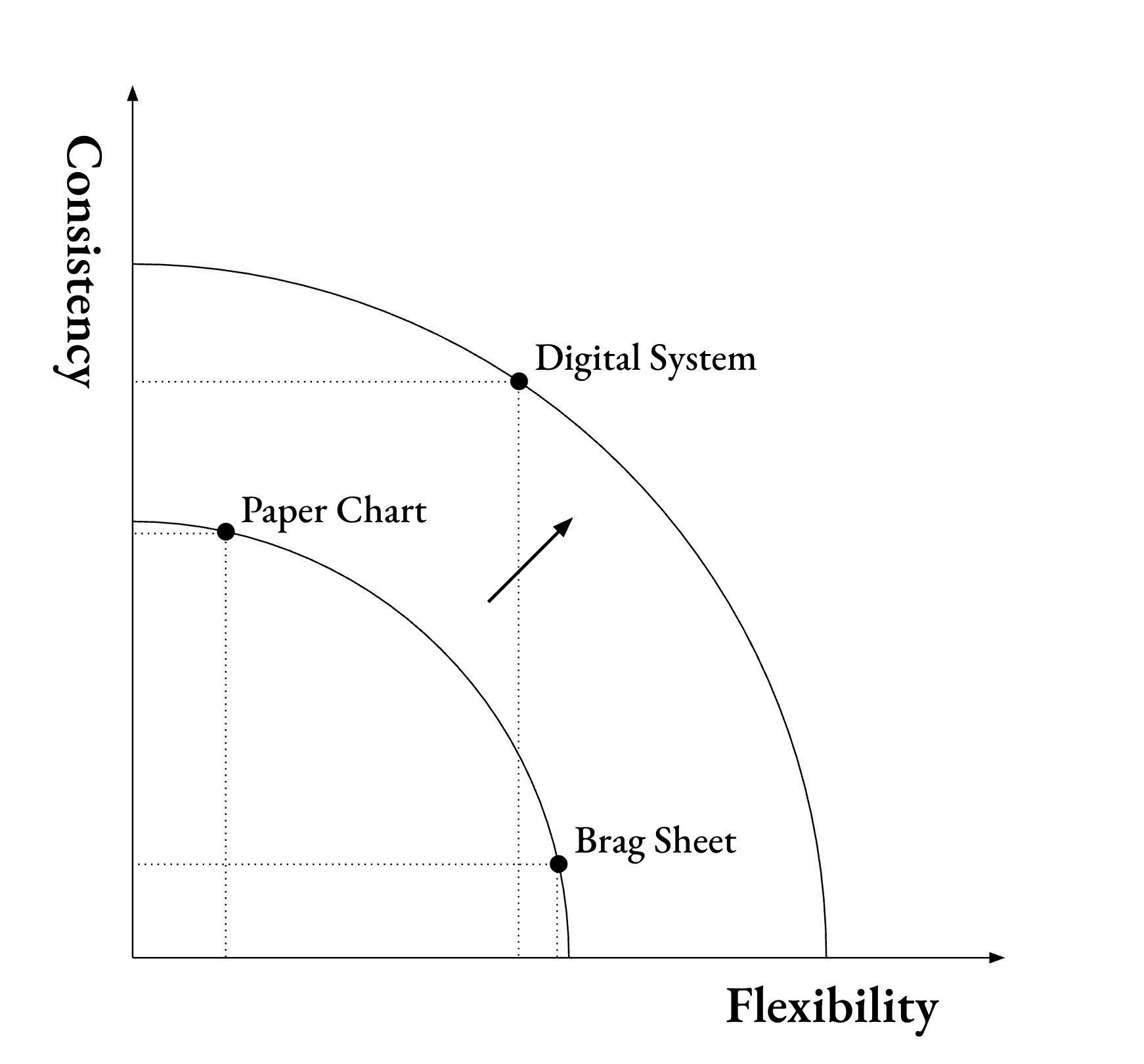
This style of image appears often in economics and science textbooks, showing what is known as a “Pareto frontier” of technological ability. The idea is that for any given level of technological development, people make trade-offs when pursuing specific goals: freedom vs. security, cost vs. quality, and so on. What technological development does is let people move beyond the frontier — more freedom and more security, lower cost and higher quality. By leveraging new affordances, dynamic digital chore systems don’t simply choose a different set of trade-offs — they enable groups to achieve higher levels of flexibility and consistency simultaneously.
Special Chores
There is no shortage of people on the internet claiming breathlessly that their latest gadget or gizmo has “advanced the Pareto frontier” for something-or-other. If we want going to make that claim, we’ll have to show our work. Why exactly does a digital system like Chore Wheel unlock higher levels of flexibility and consistency compared to alternatives like paper charts and bragging boards?
The answer is in the way that it allows a separation between work definition and work performance.
Consider the “special chore” — a one-off task like reorganizing a closet or arranging a gallery wall — which everybody wants done but nobody will spontaneously do. Chore Wheel makes it possible for person A to propose the special chore at time T1, the housemates to approve it asynchronously, and then for person B to complete the chore on their own terms at future time T2. It is this separation in time and space between task definition and task execution that is the organizational unlock.9
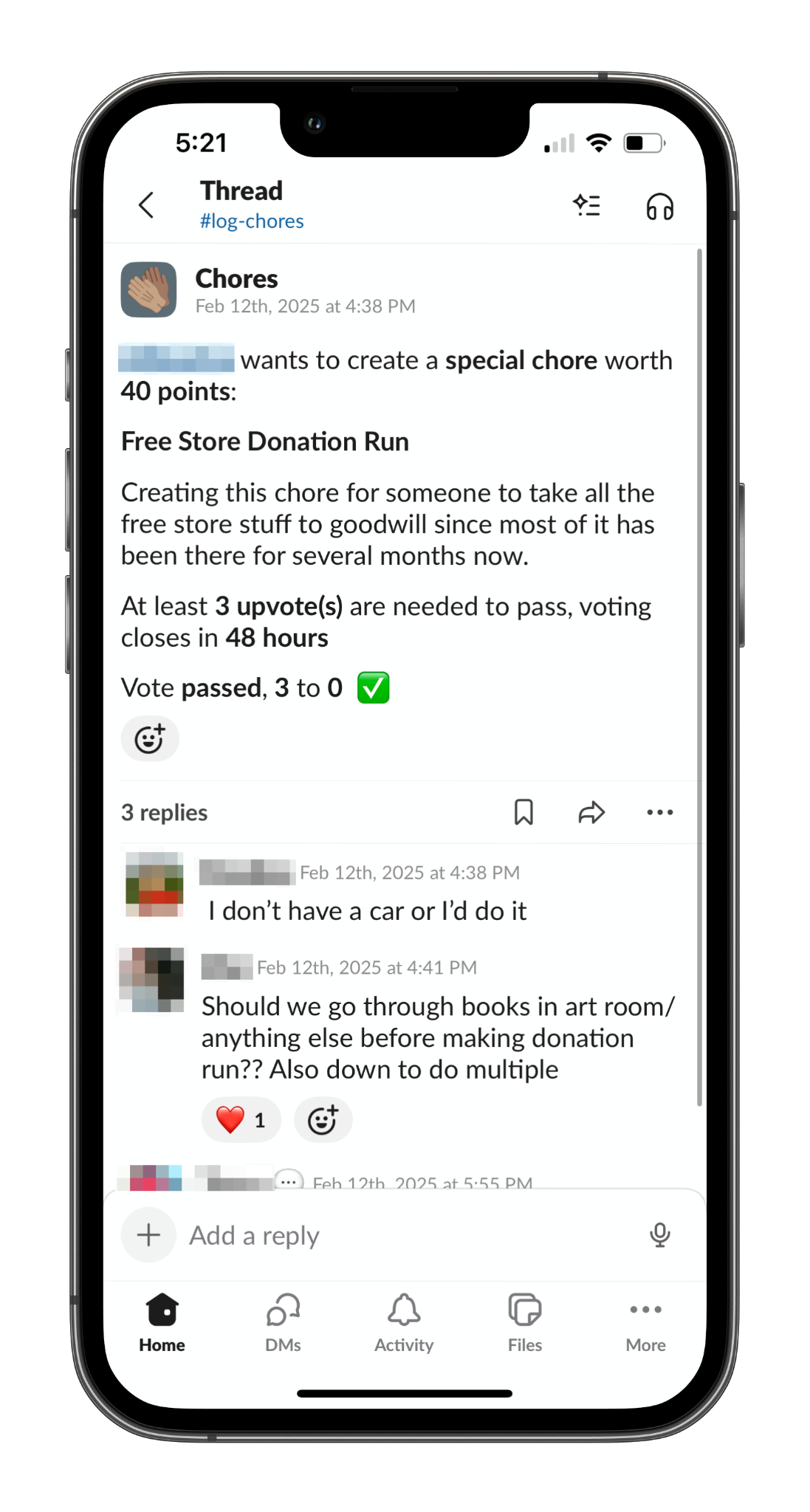
While it might seem simple on its face, several things need to be in place before this can be possible at all:
A shared unit of account (points)
A shared expectation of contribution
Programmatic bookkeeping (with lazy consensus)
Without these elements in place, the system wouldn’t work. Without a shared unit of account, there would be no ability to scope out the task. Without a shared expectation for contributions, there would be no reason to complete it. Without programmatic bookkeeping and lazy consensus, the extra overhead (meetings, management) required to administer the system would put people off. Only with all of this in place does the “technical movement” of the special chore become possible.
The natural counter-argument: “Someone could just make a donation run and brag about it. This is overkill.” It’s a fair point, but overstated. Yes, someone could make a donation run and brag about it. But that would still require simultaneous intention and action. The person who wanted to do the donation run and the person who did the donation run would need to be the same person at the same time. Bragging has no affordances for separating these roles, which limits its range of expression.
It is this flexible, asynchronous separation of intention and action — which neither paper charts nor bragging allows — that allows digital systems to advance the Pareto frontier of flexibility and consistency.
Coda: In Defense of Bragging
Before wrapping up, it’s worth giving credit where credit is due, and talking about what bragging actually does well: make it easy to get started.
In the two-plus years since we made Chore Wheel public, we’ve had over a dozen groups try it out, and many more show interest. The outcomes have been mixed — some groups churned quickly, others use it daily — and we’ve learned a lot about the circumstances in which groups succeed.
A big challenge, we’ve found, is that while Chore Wheel is easy to use once set up, getting there requires coordination and buy-in. There usually needs to be an instigator — often, a house leader who is burning out — as well as some sense of shared commitment. The gaps between “we could handle chores better” to “this is cool, let’s try it” to “we’ve successfully onboarded” are large, and it’s harder to generate enthusiasm for labor systems than it is, let’s say, for trading memecoins.
Bragging boards, by contrast, are easier to start. All it takes is for one person to say “here’s a Slack channel, I’m going to start bragging.” They start, and others can easily join in and start bragging also. There’s no overhead, no onboarding— just enthusiasm and opt-in.
From an institutional design perspective, this low startup cost is valuable, as it means that bragging boards can succeed in environments of minimal or scattered buy-in. The Pareto curve I showed earlier displayed only two dimensions — flexibility and consistency — out of many. On a different curve, perhaps emphasizing “simplicity” or “ease-of-adoption,” bragging might come out stronger.
A broader point, which Seth Frey would make often, is that the value of any governance scheme is as much a function of the people using it as the scheme itself. Governance is what we would call “reflexive” — people change their behaviors based on which system they’re in, and their perceptions of that system, which changes the outcomes achieved by the system itself. Different personalities will succeed more or less under different systems, and the same scheme freely chosen will lead to different outcomes than one imposed from the outside.
Sage House, where residents sign flexible leases, source housemates from Facebook or Craigslist, and operate without an appointed manager, has different constraints than a place like Radish, which sources exclusively through friend networks, and has a specific and stable inner culture with clear in-house leadership (Zablocki’s “charisma”). Both are “coliving” on the surface, but the dynamics are fundamentally different, and so are their needs for the “social technology” of systems and process.
Communes, as Zablocki noted, can be effective laboratories. The institutional arrangements documented here — bragging boards, paper charts, digital systems — are modest in scope, but instructive. What they show is that the constraints we accept as inherent are not inherent at all, but are functions of the institutional technologies we have available.
New technologies enable new forms of coordination — and chores are one of the places where this becomes visible. The decoupling of task definition and task execution enables complex coordination by extending flexibility without sacrificing consistency. Other innovations will lead to other benefits. The communitarian folk-science tradition has created real improvements in people’s lives; it’s a tradition to which we are happy to contribute.
If you live in a shared house of 5-15 people and are interested in improving your coordination around domestic labor, consider Chore Wheel. It’s open-source, privacy-focused, and free to use, and every new house teaches us something and helps us improve. If this sounds right for you, visit the website or contact us directly.
I literally named the tools “Chore Wheel” so this was to be expected.
“Explorations” mentions cleaners once, in the discussion of what was being governed, as “Utilities (cleaner, gardener, odd home fixing jobs).” “Fairness” mentions cleaners zero times.
The Wikipedia example is also somewhat misleading: “Fairness” presents Wikipedia editing as analogous to chore performance, despite the fact that non-editors impose no costs on editors, whereas non-chore-doers impose high costs on chore-doers; the online/offline settings are not equivalent. The example also skips over the role of the Wikimedia Foundation’s paid staff, who provide essential support and infrastructure.
Note that this doesn’t mean that it’s net-negative on overall satisfaction — housemates might be genuinely happier doing fewer chores and paying more for cleaning.
In fairness, food service at Sage is more modest than at Embassy and RGB, consisting of about $500/mo of Costco deliveries.
In a memorable twist, I would immediately follow RGB’s talk with my own (virtual) presentation of Chore Wheel, which created a charming, if awkward, moment.
Seth and I first met in the Berkeley co-ops, which should surprise nobody.
We can make a flattering but not inaccurate analogy to the development of double-entry bookkeeping in 13th-century Italy, which unlocked significant organizational complexity by making it possible to decouple inputs and outputs in financial transactions.